Versailles, 2026
A privileged class is producing a labour disruption it cannot absorb, authoring documents diagnosing the disruption. We've seen this script before. It ended at the guillotine.

On 22 February 1787, in the Hall of Menus-Plaisirs at Versailles, a finance minister stood before 144 men he had selected himself. One hundred and thirty-nine of them were nobles. Seven were princes of the blood. Seven were archbishops. There were fourteen marshals of France and a sprinkling of magistrates from the parlements. Five members of the third estate sat among them, almost as garnish.
Charles-Alexandre de Calonne placed the figures on the lectern. Annual revenue, 475 million livres. Annual expenditure, 587 million. The deficit was 112 million livres a year, climbing toward 140 in the next budget. France was a fifth of its income short, every year, in peacetime. The treasury had exhausted its borrowing capacity at any rate that would close the gap. The state was months from insolvency.
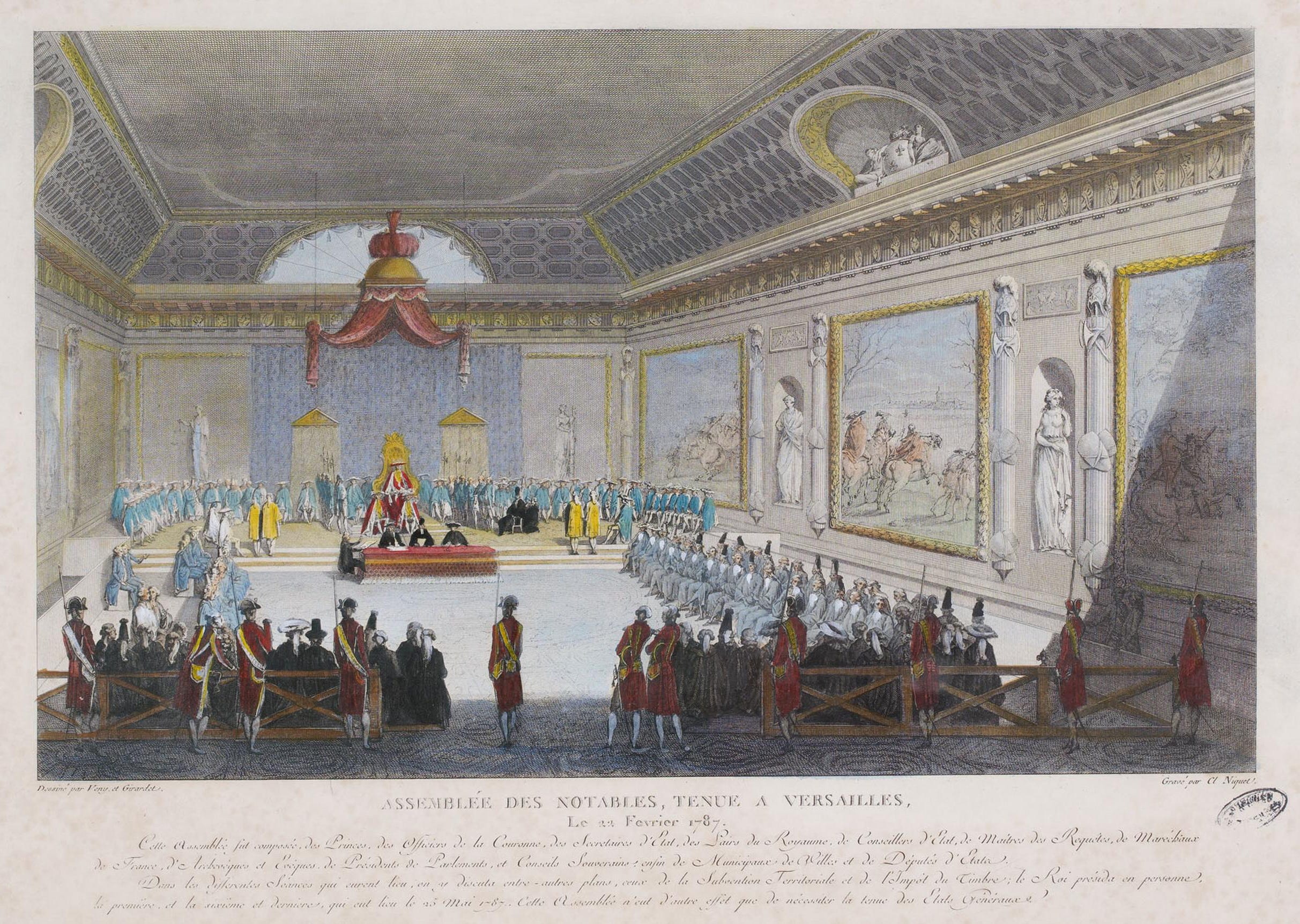
Assembly of Notables, 1787 in Versailles
Calonne then proposed the remedy. A subvention territoriale, a uniform land tax assessed on every property in the kingdom regardless of the owner’s status.
He framed it as moral necessity. “Abuses are defended by self-interest, influence, wealth and ancient prejudices which seem to be hallowed by time. But what are all these together compared with the common good and the necessity of the state?”
Its cornerstone was the suppression of fiscal privilege. The 144 men in the room held that privilege. Calonne was asking them to vote it away.
He had misread the room, and human nature.
The Notables refused. Some questioned his deficit figures. Some demanded that only the Estates-General had standing to authorise new taxes. Some asked for verification of accounts the monarchy had concealed for a century. Most refused on procedural grounds and for one underlying reason: the men in the room held the privilege the proposal would suppress.
Two years and four months later, on the night of 4 August 1789, the National Assembly sat through a single emergency session and abolished feudal privilege in France. The session ran past midnight. By dawn, the subvention territorialeand a great deal more had been imposed by force of revolution on the same class that had refused to grant it by negotiation in 1787.
Outside, the countryside was burning. The Bastille had fallen three weeks earlier.
The nobility had held the choice in February 1787. It had refused. The choice was then taken from it.
The privileged had lost their vote on whether reform would happen. They now held only a position on the gradient between dignified withdrawal and violent dispossession.
In late January 2026, Dario Amodei published a 20,000-word essay on his personal blog, The Adolescence of Technology. The piece described “a country of geniuses in a datacenter” and walked through five categories of catastrophic risk: misalignment, misuse for bioweapons, geopolitical instability, surveillance autocracy, and economic concentration.
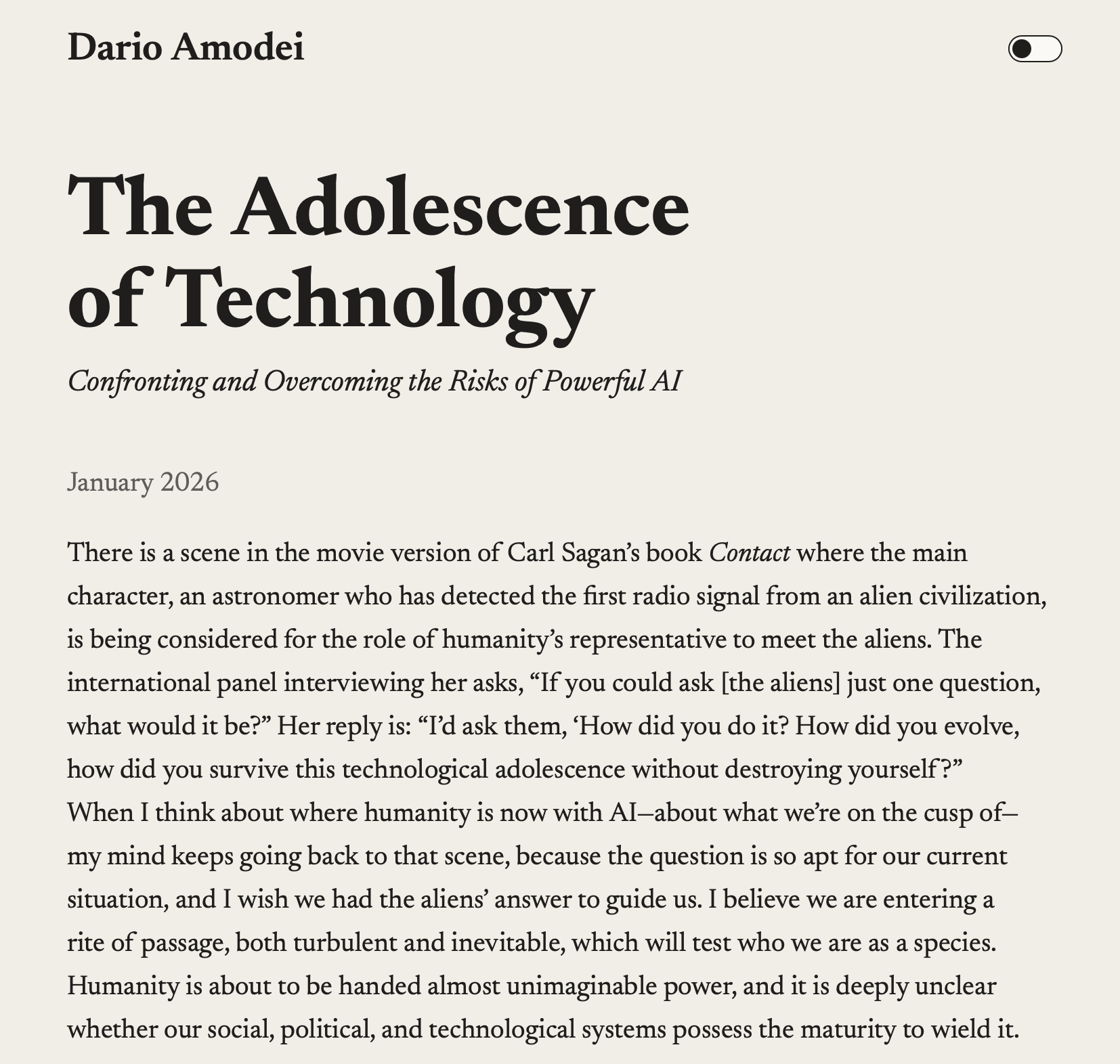
In the section on economic concentration, Amodei wrote that AI systems his own company was helping to build could leave less-skilled workers with nowhere to go, producing “an unemployed or very-low-wage ‘underclass.’” He argued that the displacement would advance from the bottom of the ability ladder upward, that AI risked entrenching inequality at levels which would, “break society.” He stated that the balance of power in democracy depended on the average person retaining economic leverage, and that this leverage was going.
Then he proposed the remedy. Wealthy individuals had an obligation to help, especially the wealthy in technology. Anthropic’s co-founders had pledged to donate eighty percent of their wealth to philanthropy, and Anthropic’s employees had pledged billions of dollars in shares to charity, with the company matching. He criticised others in Silicon Valley for adopting what he called a cynical and nihilistic attitude toward giving. He suggested that AI companies should steer their enterprise customers toward deployments that produced new revenue, with labour savings as a secondary effect.
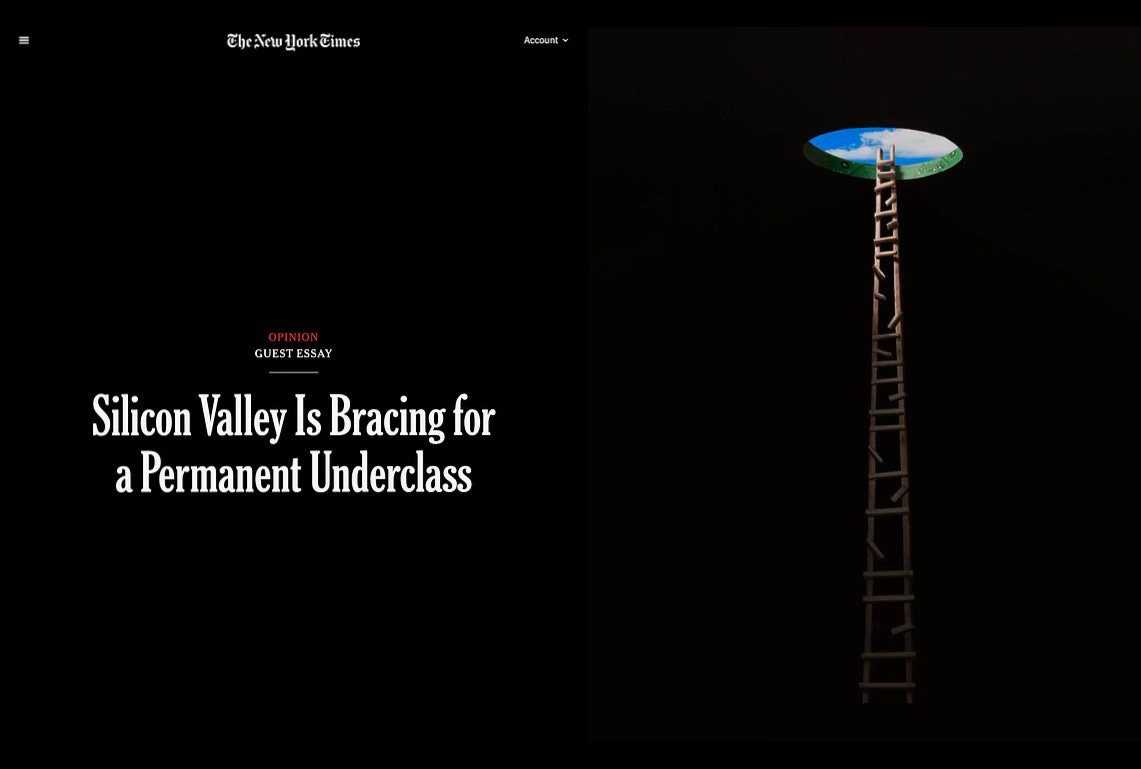
Three months later, on 30 April 2026, the New York Times published a piece by Jasmine Sun titled Silicon Valley Is Bracing for a Permanent Underclass. Sun reported that the consensus inside the AI industry was that the median person was “screwed.” She quoted disappearing Signal chats in which executives boasted about the roles they planned to automate. She quoted Anthropic’s co-founder Jack Clark, asked whether AI would create a permanent underclass, replying that this was basically “a societal choice.” She quoted Sam Altman telling The Atlantic that his “belief in universal basic income had cooled since he first championed it.” She reported that Palantir’s Alex Karp had told a panel that the “country could blow up politically and that none of them would make money when it did.”
These are two documents. One was written by a finance minister in 1786. The other was written by an AI executive in 2026. They are doing the same structural work.
Both diagnose accurately. Both propose redistribution-adjacent remedies. Both are authored by figures whose personal standing depends on the system the document asks the system to alter.
The two documents are the same document, written 240 years apart.
Both ask the privileged class to act against its interest. Both will be ignored. The question is why.
There are three reasons. They build on each other.
The first is who is talking. Calonne was a courtier. He owed his appointment to court patronage and his salary to the same fiscal system he was proposing to reform. His personal standing depended on remaining a member of the class he was addressing. The 144 nobles in the Hall of Menus-Plaisirs read his proposal in that context. They knew he had to live among them after the speech ended. They knew the king could be persuaded to dismiss him if the room was unhappy. They knew, in other words, that nothing he said was binding.
Amodei occupies the same position. He runs a company whose continued growth depends on the same labour displacement his essay describes. He pays salaries with the proceeds of that displacement. He holds equity that has appreciated forty-fold in three years on the same dynamic. The investors and other founders who read the essay in late January knew that Amodei would still be running the company in February, March, April. They knew, therefore, that everything in it was advisory.
An insider’s document describes the room. The room reads, and continues.
The second reason is that the remedies are voluntary. Calonne’s reform required noble assent. Amodei’s pledges, donations, and steered enterprise deployments require voluntary uptake by other founders, other boards, other shareholders. Voluntary remedies for collective-action problems have a track record across centuries and across continents.
The track record is zero.
Class-based extraction has ended in only four ways: through force, through revolution, through external defeat, through demographic collapse. On every documented occasion in the modern era, the class doing the extracting has been removed by other people. Voluntary redistribution from inside the benefiting class belongs to the same historical category as voluntary monarchical abdication. It happens when the abdication is already underway.
The redistribution they describe is structurally impossible from where they are standing.
The third reason is the one the first two are setting up.
The document protects the author from the consequences of refusal. It functions as a record. When the fallout arrives, the author can produce the essay. He can hold it up. He can say, accurately, that he warned. That he proposed redistribution. That he pledged. That the system failed to act on what he had laid out at length and at considerable personal expense of time and standing. The essay positions the author as the conscientious member of an unconscientious class. Which is to say, the essay is part of the catastrophe, costumed as the remedy.
Calonne understood this with an honesty Amodei has yet to match. After his dismissal, Calonne wrote: “The king, who assured me a hundred times that he would support me with unshakable firmness, abandoned me, and I succumbed.” The minister had proposed. The class had refused. The minister had been removed. The proposal remained on paper, where it served no one and exonerated the minister. Calonne died in his bed in Paris in 1802, restored to favour under Napoleon, the revolution behind him.
The 20,000 words on the blog do the same work in 2026 that the memorandum did in 1787. They put the author on the record. They permit the class addressed by the document to do nothing while citing the document as evidence that something is being done. They establish, in advance, who among the privileged will be remembered as having said the right things.
The document is the alibi. Everything else is the catastrophe.
The privileged have begun to misname themselves.
Sun’s New York Times piece catalogued the language young Silicon Valley researchers now use about their own situation. They post on X about having “five months to escape the permanent underclass.” They circulate a tweet from Nic Carter, a partner at Castle Island Ventures, that reads: “everyone I know believes we have a few years max until the value of labor totally collapses and capital accretes to owners on a runaway loop. this is the permanent underclass thing. and everyone I know subscribes to it.”
