The Emperor’s Disease
In a single year, the rich and powerful spent $8.5B trying to outrun aging and stretch their lives. This is what that money is really buying.

The most powerful man in the ancient world spent the last decade of his life searching for an elixir that would let him live forever.
The Man Who Drank Mercury
In 221 BCE, Ying Zheng, king of the state of Qin, finished conquering the six rival kingdoms that had spent two and a half centuries killing one another across the plains of what would become China. He invented a title for himself and became the first ruler ever to carry it. Qin Shi Huang. First Emperor.
He standardized the written script so that an order issued in the west could be read in the east. He standardized the coinage, the weights, the legal code, and the width of cart axles, so that every wheel in the empire would fit the ruts of every road. He linked the northern fortifications into the spine of the structure the world would later call the Great Wall. By every measure available to a human being in the third century before Christ, he had won.
And he was terrified of dying.
The fear grew as the empire settled. He had unified a world. He intended to keep it forever. So he summoned the fangshi, the masters of method, the alchemists and diviners who claimed knowledge of the deathless. They told him what he wanted: that somewhere beyond the eastern sea lay islands where immortals lived, and that on those islands grew the herb that ended dying.
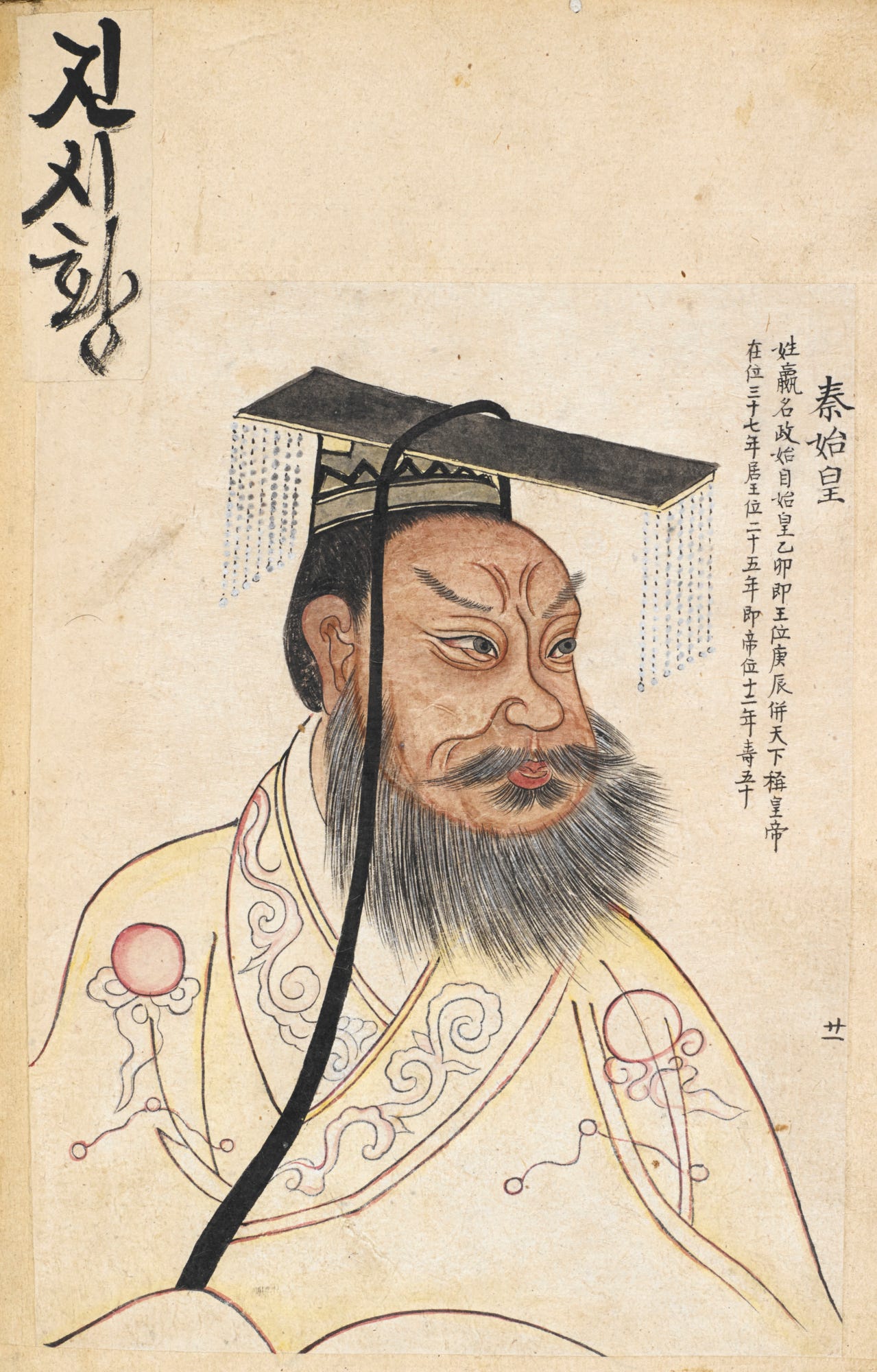
Qin Shi Huang, first emperor of China.
In 219 BCE, a court magician named Xu Fu petitioned the emperor with a plan. Three islands rose from the eastern ocean, Penglai and Fangzhang and Yingzhou, and on them dwelt the immortal Anqi Sheng, who was said to be a thousand years old. Xu Fu asked for ships, provisions, and a crew. The emperor gave him three thousand young men and women, virgin boys and girls to please the immortals, and sent the fleet east into the water to bring back the cure.
Xu Fu sailed for years. He found nothing. He came back with a story about a great sea creature blocking the route, and the emperor, who commanded the largest army on earth, dispatched archers to the shore to shoot a fish.
In 210 BCE Xu Fu sailed a second time and vanished into the eastern water for good. A legend that surfaced a thousand years later holds that he landed in Japan and named a mountain there Penglai, and ruled. He died like everyone else.
While the fleet searched the sea, the chemists searched the laboratory. They ground cinnabar, the brilliant red ore of mercury sulfide, and prepared it as medicine. Mercury was thought to carry the property of permanence. It held its shine while iron rusted to flakes. It stayed bright and liquid, and it moved like something alive.
The reasoning had the clean logic of all magic: take into the body the one substance that resists all rot, and the body will hold. The emperor swallowed it. He swallowed it for years.
And while he drank the metal that was supposed to keep him on this side of the grave, seven hundred thousand conscripts were digging him a home on the other side. Beneath a man-made mountain near present-day Xi’an, an army of terracotta soldiers stood in battle formation to guard him after death. Sima Qian, writing a century later in the Records of the Grand Historian, recorded what lay deeper: a chamber with the heavens painted above and the rivers of the empire laid out below, the Yangtze and the Yellow River rendered in flowing mercury, set in motion by hidden machines.
In 2002, soil scientists found the proof. The ground above the sealed chamber still carries mercury many times the natural level, in the pattern of China’s rivers.
He was hedging. He wanted the cure, and he built for its failure.
In 210 BCE, on an imperial tour through the eastern provinces, the cure finished its work. He died at Shaqiu, far from his capital, at forty-nine.
His chancellor Li Si understood that the news would shatter the empire before the body could reach home, so he kept the death secret. It was high summer. To bury the smell of the rotting emperor, they loaded a cart with abalone and drove it ahead of the procession, so that the stench of dead fish would cover the stench of the dead god-king all the way back to the capital.
His chief eunuch and his chancellor used the secret weeks to forge his will, order his eldest son to kill himself, and install a younger son they could control.
Within four years the dynasty that was meant to last ten thousand generations had fallen.
This is the oldest version of the story. The most powerful man on earth treats his mortality as an engineering problem, assembles the finest specialists of his age, and they cure him to death.
The Most Measured Man Alive
Twenty-two centuries later, in a rented house in Venice, California, a man wakes in the dark and begins to measure himself.
His name is Bryan Johnson. In 2013 he sold his payments company Braintree, which owned Venmo, to PayPal for $800M. In 2021 he turned that fortune toward a singular objective: Don’t die. He spends more than $2M a year on it. A team of more than thirty doctors tracks more than a hundred biomarkers in his blood, his organs, his sleep, his skin. He counts the erections he has each night and logs them as data on the health of his cardiovascular system.
He has published a measurement claiming the heart of a thirty-seven-year-old, the skin of a twenty-eight-year-old, and the lung capacity of a teenager. He is forty-seven.
He carries an umbrella on clear days. Asked why, on a cloudless afternoon with the ultraviolet index low, he gave the reason precisely: ninety percent of the physical aging of skin comes from the sun, and the umbrella holds the sun off. There are photographs of him shielding his face from open daylight as though from a falling object.
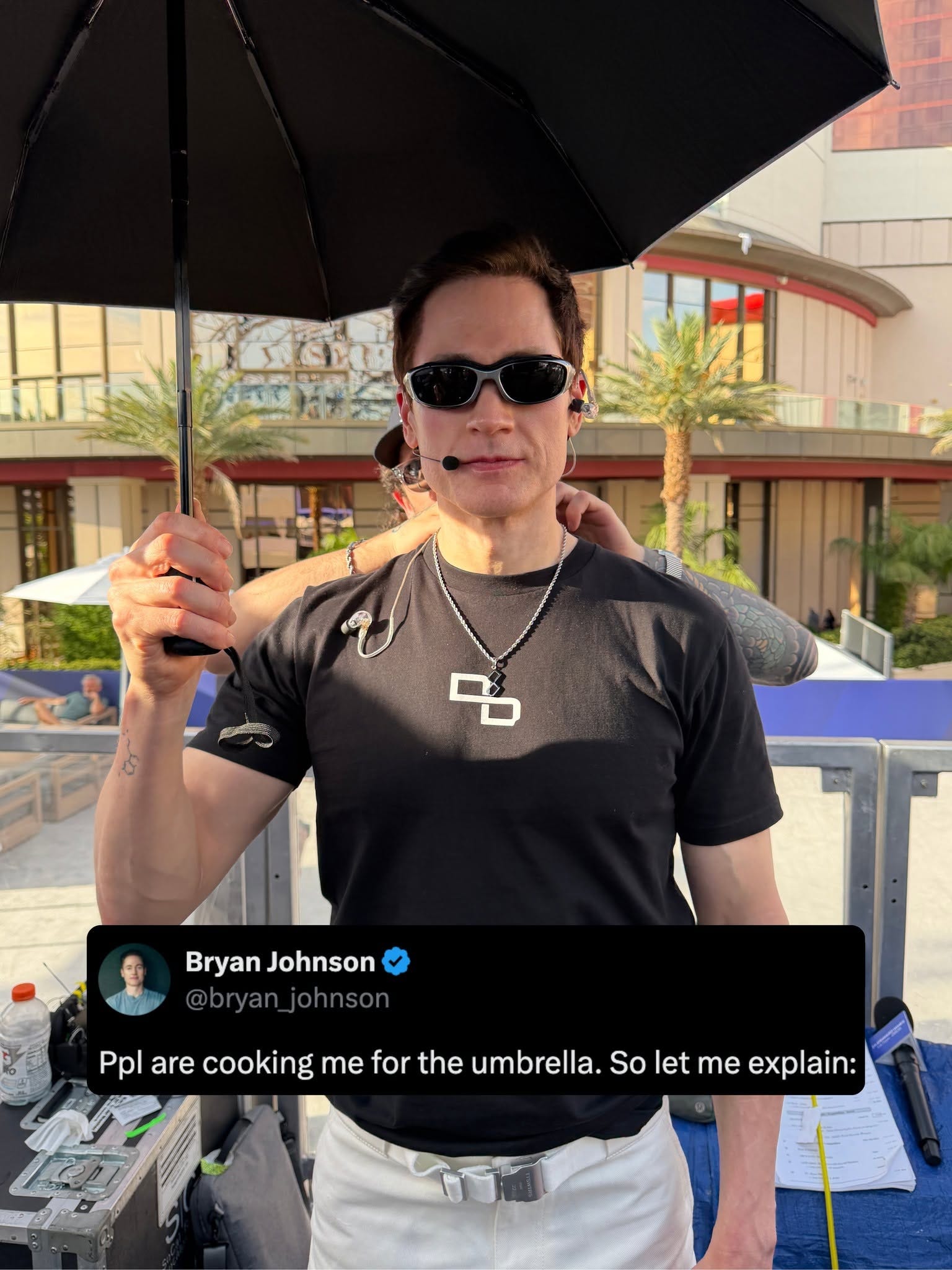
To Johnson they document a man behaving rationally in the presence of a known carcinogen. The light that every other human being on the street received as warmth, he received as damage, and he had the instruments to read the dosage.
This spring his girlfriend, Kate Tolo, who helped build his longevity company, asked him to fly to Australia to meet her parents. He went, and he warned his audience about the cost. The last time he had crossed that many time zones, his instruments recorded the toll: nine extra days of aging in his blood-sugar stability, nine in his circadian rhythm, eighteen in his sleep.
He framed the trip as an act of love conducted at measurable expense to his lifespan. The biological cost of travel, he said, is not a price tag that people are aware of. He had built a life in which meeting the parents of the woman he loved registered, on the dashboard, as an injury.
A few years earlier he had gone further into the family. On a clinic table near Dallas, Johnson had a liter of his teenage son’s blood plasma transfused into his own veins, while his own plasma went into the veins of his seventy-year-old father. Three generations of one family, plumbed together, the young blood flowing upward toward the man in the middle who was trying to climb back down the slope of his own age.
He measured the results. He found nothing. He stopped, and reported the failure with the same flat precision he reports everything, and moved on to the next intervention.
In February of 2026 he opened the protocol to the public and called it Immortals. The price of admission was $1M a year. Within thirty hours, more than fifteen hundred people had applied.
The Company He Keeps
It would be convenient to file Johnson under eccentricity, a rich man with a strange hobby photographing his own decline. The applications tell a different story. So does the company he keeps.
In June of 2026, a security researcher pried open an Airtable database belonging to Dialog, the invitation-only society that Peter Thiel founded in 2006 to convene senators, regulators, foreign officials, and the wealthiest builders in technology at off-the-record retreats. The leak exposed the membership and the paperwork. Beneath the names and the private phone numbers, a pattern surfaced in what these people read and feared and wanted.
The registration forms asked members to predict the future, and they returned, again and again, to two subjects: artificial intelligence, and longevity. Among the books they pressed on one another, beside Marcus Aurelius and Milan Kundera and Thiel’s own Zero to One, was Outlive, the longevity manual by the physician Peter Attia. The most powerful private network in America was passing around the same preoccupation as the man with the umbrella.
Thiel has said so openly. He has signed a contract with Alcor to have his body frozen at the moment of legal death, on the chance that a later century can thaw and repair him. He has called death “a bug in the program.”
He has put millions into the Methuselah Foundation, which funds research to reverse the biology of aging, and he has spoken admiringly of parabiosis, the transfusion of young blood. On a podcast he was asked whether humanity could defeat death, and he answered that the scandal was “our failure to seriously try.” “We should either conquer death,” he said, “or at least figure out why it’s impossible.”
He is one node in a balance sheet. Jeff Bezos and Yuri Milner put roughly $3B behind Altos Labs to reprogram aging cells. Google’s founders built Calico and funded it in the billions. Sam Altman put $180M of his own money into Retro Biosciences, which now carries a valuation in the billions, to add ten years to the human span. The Saudi crown, through its Hevolution Foundation, has committed $1B a year.
In 2024 alone, longevity companies raised some $8.5B across more than three hundred deals.
The Laundered Word
The vanity is old. The powerful refuse to die, and they have wanted this for as long as there have been powerful people. For most of that history the wanting was read as a weakness, the thing that came for a ruler near the end, when the fist finally closed on the one prize beyond its reach.
What changed in the last decade is the vocabulary. The fountain of youth was a fool’s errand and the mark of a tyrant losing his grip. Today it is a research program with a board, a Nobel laureate, and a term sheet.
The word that carried the change is longevity. For most of its life it described a fact about a population. A people had longevity, or a family did, and you measured it after the burials, in graves and parish registers.
Around 2013 the word turned. It became a discipline you could practice, a market you could fund, a movement you could join. The turn moved the wish to live forever out of the country of hubris and into the country of health, and health is the one appetite every person is required to respect.
Peter Attia gave the laundered word its bible. Outlive sat on the bestseller list across 2023 and 2024 and became the single text the optimization class agrees on.
Its argument is disciplined and well-built. It names the four diseases that kill most people in rich countries, heart disease and cancer and neurodegenerative decline and type 2 diabetes, and it calls them the Four Horsemen. It separates lifespan, the count of years, from healthspan, the count of good ones, and it asks medicine to chase the second.
